Introduction
When you admire a diamond today, you see symmetry, brilliance, and precision. That perfection did not appear instantly. The history of diamond cutting reveals a long journey of experimentation, correction, and innovation.
Before we dive into the history of diamond cuts, it is essential to know what is diamond cutting? It is the process of shaping a rough diamond by creating facets, refining the crown and pavilion, and polishing it to maximize brilliance and sparkle.
If you want to understand modern diamond design, you must first understand the history of diamond cutting. Each era solved a problem and pushed craftsmanship forward. That steady progress shaped the diamonds you see in jewelry stores today.
History of Diamond Cuts
Early craftsmen focused on preserving weight because tools were limited. Over time, they learned how light travels through a stone and adjusted facet angles to increase brilliance. This gradual evolution of diamond cutting changed diamonds from rare crystals into engineered gemstones.
The Beginning of Natural Crystals and the Point Cut (14th Century)

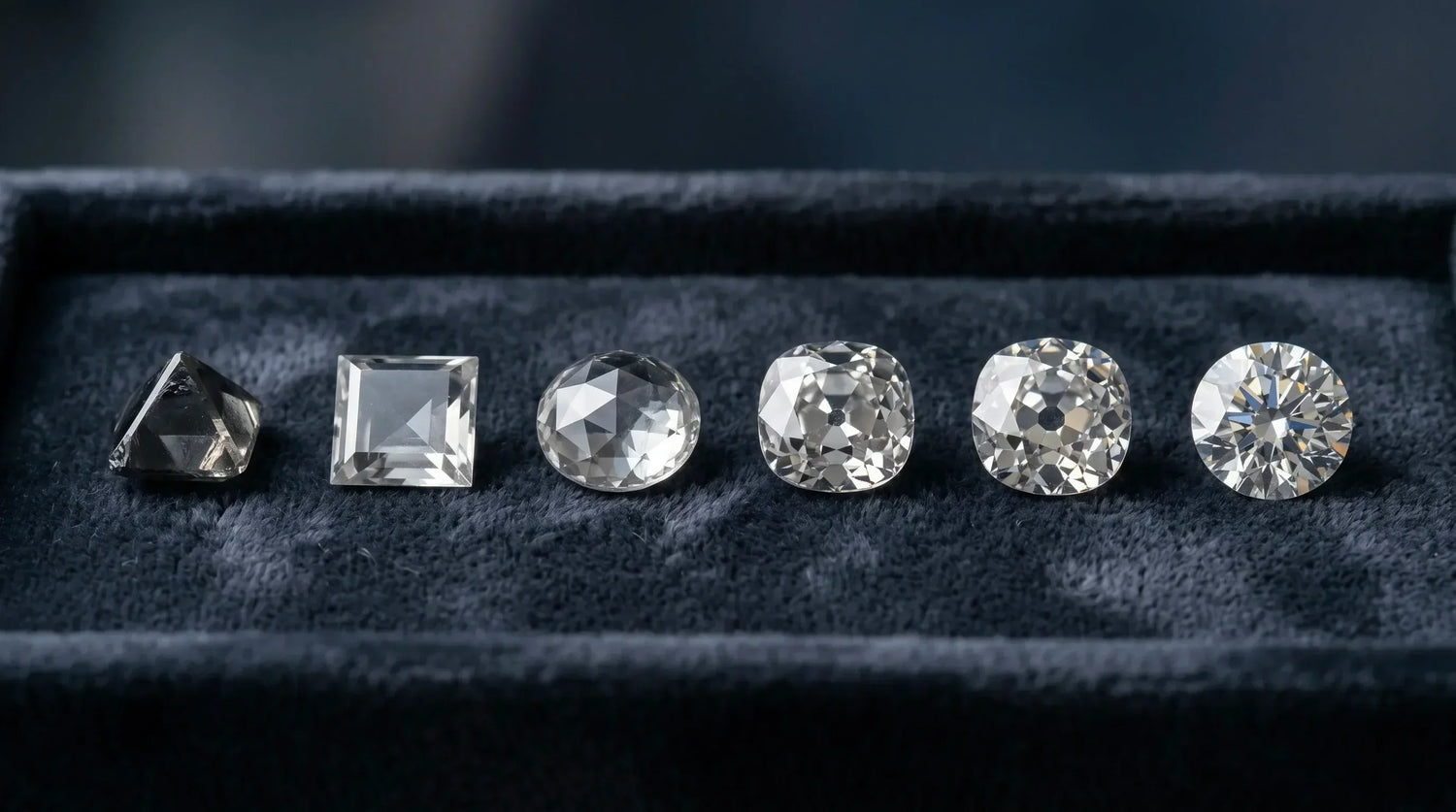
Diamonds were first mined in India, where craftsmen polished natural crystals instead of reshaping them. They created the Point Cut by keeping the stone close to its original octahedral form. This approach protected carat weight and maintained durability.
At that stage, cutters did not fully understand light reflection. Sparkle was secondary to preservation. Even so, this early phase of the history of diamond cutting proved that shaping a diamond was possible.
The Renaissance Shift (15th–16th Century)

Shop Art Deco Style Diamond Ring
During the 15th and 16th centuries, European trade expanded and wealth increased. Jewelers responded by introducing the Table Cut, which featured flat top surface, step like facets and a truncated point . This design allowed light to enter the stone more effectively.
For the first time, cutters focused on improving brilliance instead of simply polishing surfaces. This shift marked a major step in the evolution of diamond cutting. Modern diamonds still rely on the table facet introduced during this period.
The Rise of the Rose Cut (16th–17th Century)

As candlelight filled European homes, jewelers had to adjust their approach. Diamonds needed to appear bright in low light, or they would lose their appeal. This demand led to the rise of the Rose Cut.
The Rose Cut featured:
-
A flat base
-
A dome-shaped top
-
Between 3 and 24 triangular facets
This structure reflected soft candlelight, giving the diamond a gentle glow. It became popular in Georgian and Victorian jewelry and remains a favorite in vintage-inspired designs today.

3.84 карат Арт-деко стиліндегі көк сапфир және гауһар тастармен безендірілген сақина 18 карат ақ алтыннан жасалған
A finely detailed Art Deco style ring in solid 18K white gold, centered with a 1.52 carat GIA certified old-mine European cut diamond graded J color and VS2 clarity. French cut blue sapphires and single cut diamonds frame the round ring face, giving the piece strong period character and refined antique-inspired structure.
$25,000.00
Buy NowThe Rise of Brilliant Cuts (17th Century)

Shop Vintage Inspired Engagement Jewelry
In the 17th century, craftsmen experimented with increasing facet counts. Designs such as the Mazarin and Peruzzi cuts introduced a structured 58-facet arrangement. More facets meant stronger internal reflection and visible sparkle.
This period laid the foundation for many modern types of diamond cuts. Cutters began applying geometric thinking to control how light behaved inside the stone. Brilliance became intentional rather than accidental.
The Old Mine Cut (18th–19th Century)

Shop Old Mine Cut Diamond Medallion
The discovery of Brazilian diamond mines in the 18th century increased supply across Europe. Cutters developed the Old Mine Cut, which featured,
-
Cushion-like shape,
-
High crown,
-
Small table
-
Large culet
This structure performed well under candlelight and preserved more rough weight.
The Old Mine Cut directly influenced today’s cushion designs. When customers explore types of diamond cuts, they often encounter this historical predecessor. Its bold proportions still inspire vintage-style engagement rings.
The Old European Cut (Late 19th–Early 20th Century)

Electric lighting changed interior spaces in the late 19th century. Diamonds now needed to perform under brighter conditions. Cutters refined symmetry and created what became known as the Old European Cut.
This design introduced
-
Rounder outline
-
Better alignment
-
Improved light return
It served as the bridge between antique styles and modern standards. The history of diamond cuts shows clear progress toward proportion control during this stage.
The Scientific Breakthrough: Modern Round Brilliant (1919)

The true turning point in the history of diamond cutting came in 1919.
Marcel Tolkowsky, a mathematician from a family of diamond cutters, published a study defining ideal proportions for maximum brilliance.
Marcel Tolkowsky calculated:
-
Ideal crown angle
-
Pavilion depth
-
Table size
-
Total depth percentage
He concluded that 58 facets produced optimal light reflection.
This research transformed the history of diamond cuts. Today, more than 70 percent of engagement rings worldwide feature the Round Brilliant Cut, which follows Tolkowsky’s proportion model.
The Expansion of Shapes: 20th Century Innovation
The 20th century introduced laser technology and computer modeling. These tools allowed cutters to experiment with greater precision and less material loss.
The list of diamond cuts expanded rapidly:
-
Princess Cut
-
Emerald Cut
-
Asscher Cut
-
Oval Cut
-
Pear Cut
-
Marquise Cut
-
Radiant Cut
-
Heart Cut
The types of diamond cuts available today exist because technology advanced. Without earlier experimentation, these modern shapes would not exist.
The Science Behind Modern Diamond Cuts
The modern development of diamond cutting relies on advanced technology for precision. Techniques like 3D mapping and laser sawing shape the stone accurately, while computer modeling and proportion analysis maximize brilliance and light performance.
Brands focus on:
-
Ideal symmetry
-
Polish quality
-
Light performance grading
-
Certification standards
Institutions like the Gemological Institute of America established cut grading systems that influence buying decisions globally.
Modern cutting balances:
-
Beauty
-
Yield from rough stone
-
Market demand
-
Technical precision
How Each Era Shaped Modern Diamond Design
Each historical phase contributed something measurable to modern diamonds. Early craftsmen established shaping techniques. Renaissance cutters improved light entry through structured faceting. Brilliant-cut pioneers increased sparkle with higher facet counts.
The Old Mine and European cuts refined proportion and symmetry. Tolkowsky’s research introduced mathematical precision. Modern technology expanded creative possibilities while maintaining strict quality control.
When you examine today’s types of diamond cuts, you see the combined results of centuries of improvement.
Why This History Matters When You Choose a Diamond
Learning about the progression of diamond designs can help you choose diamonds wisely.
If you love vintage jewelry, you might prefer:
-
Cushion shapes inspired by Old Mine Cuts
-
Rose cuts for softer brilliance
If you want maximum sparkle, you will likely choose:
-
Round Brilliant
-
Princess Cut
When you explore shapes of diamond cuts, you are choosing from a timeline of design evolution. Each shape solves a different design problem.
Each cut reflects a different era’s priorities.
Conclusion
Modern diamond design makes more sense once you see how it was built. The point cut, rose cut, old mine cut, old European cut, and round brilliant each reflect a different standard of beauty and craftsmanship. Together, they explain why some diamonds show broad flashes, some give off a softer glow, and some deliver sharper brilliance.
That history still matters when you shop. It helps you look past surface sparkle and choose a diamond with the cut character you actually want.
Explore Galt Couture’s vintage style diamond jewelry for pieces that reflect the lasting influence of historic diamond cuts.