Table of Contents
- When Was The Georgian Era
- What Defines Georgian Era Jewelry At A Glance
- Georgian Metals and Alloys
- Diamonds and Gemstones Used in Georgian Jewelry
- Georgian Jewelry Setting Styles
- Construction Details That Affect Wear And Comfort
- Georgian Jewelry Care Basics
- Georgian vs Victorian Settings
- Final Thoughts
Introduction
When you look at Georgian era jewelry, you step into the earliest phase of fine jewelry as you know it today. These pieces come from a time before powered tools and factory production. Every detail depended on the jeweler's hand and judgement. That human input is what gives Georgian jewelry its quiet depth and individuality.
If you want to understand this style, you need more than dates and labels. The period behind the jewelry shapes how a piece feels, how it wears, and why it looks the way it does. Once you know the context, the design choices start to make sense.
This guide gives you that starting point. You get a clear view of the era and the fundamentals that define Georgian jewelry, so the sections that follow help you read materials and settings with confidence.
When Was The Georgian Era
The Georgian era ran from 1714 to 1837, covering the reigns of four British monarchs named George. In jewelry history, this period marks the transition from early handmade adornment to more structured antique design. If you are dating or understanding Georgian jewelry, these years set the foundation.
Key shifts across the era
-
Metal preference: High-carat yellow gold dominated, often paired with silver for diamond settings
-
Diamond cutting style: Early table cuts gave way to rose cuts designed to glow under candlelight
-
Setting construction: Closed-back collets and foil-backed stones remained standard throughout the period
What defines Georgian era jewelry at a glance
You can recognize Georgian era jewelry by its unmistakably hand-built character. These pieces were shaped, cut, and assembled entirely by hand, so you often see small irregularities in symmetry, edge finish, and stone alignment. Those details are not flaws. They show how the piece was made and help distinguish authentic Georgian work from later reproductions.
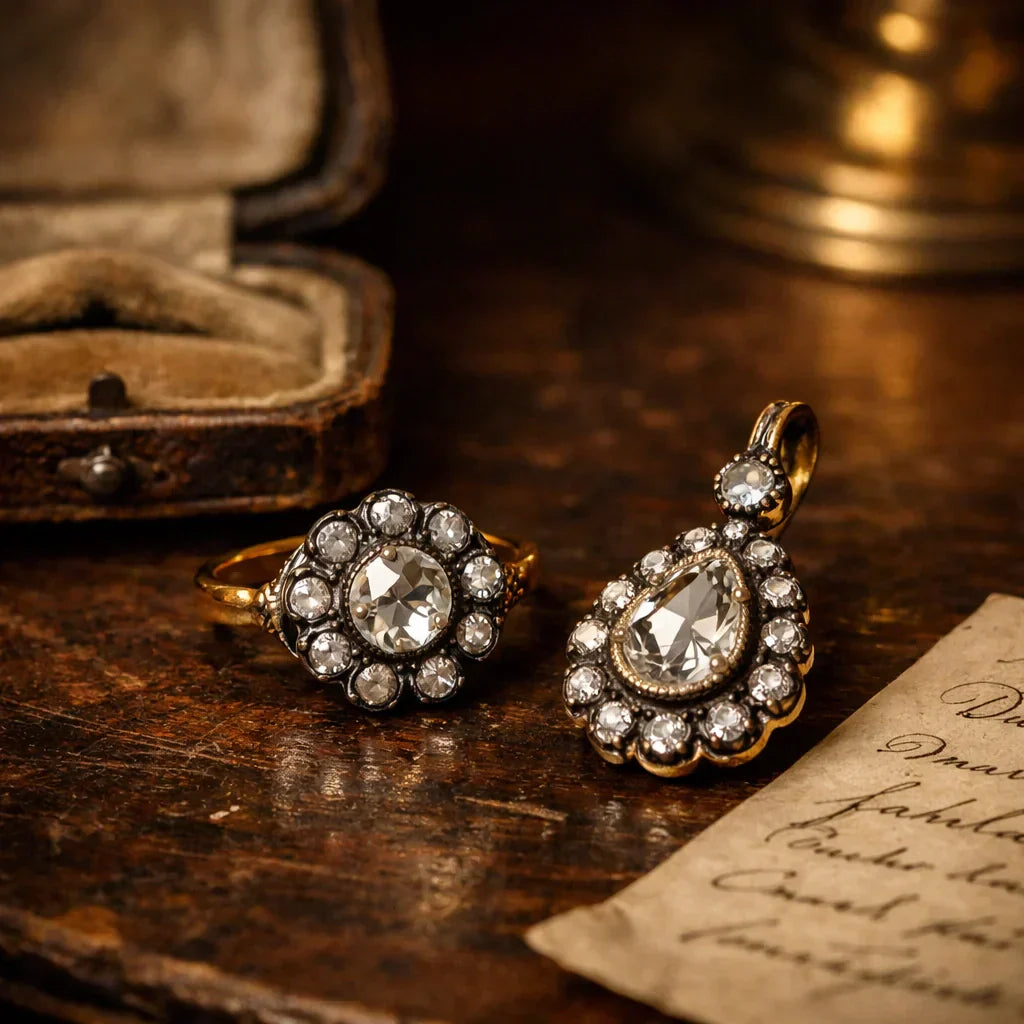
You will also notice closed-back settings across most Georgian designs. Jewelers built stones into solid metal cups to control how light reflected off the gem. This approach suited candlelit interiors and created a soft, glowing appearance rather than sharp brilliance.
Common silhouettes feel sculptural and balanced. Cluster arrangements appear often, with stones grouped tightly for visual impact. Navette shapes and gently scalloped edges add movement while keeping the overall form compact and wearable.
Georgian Metals and Alloys
You will see high-carat yellow gold used throughout Georgian era jewelry. Gold in this period often sits between 18K and 22K, which gives it a deep, warm color and a softer working quality. That softness allowed jewelers to shape metal by hand and create fluid forms, though it also means these pieces show wear more easily over time.

Diamond Vintage Style Floral Flower Cluster 9K Rose Gold Ring
9K rose gold floral cluster ring set with a 0.11 carat round natural diamond at the center and eight round accent diamonds totaling 0.21 carat. This delicate vintage-style design features H color, SI clarity diamonds and a refined flower silhouette.
$2,200.00
Buy NowFor diamond settings, jewelers often used silver-topped gold. A thin layer of silver was applied over gold so diamonds appeared brighter and less yellow under candlelight. This technique improved contrast without changing the overall structure of the piece.
Surface finishes tend to look subtle rather than glossy. Hand-polished gold shows gentle variation, while chased detail and repoussé work add texture and depth through raised and recessed metal shaped from the reverse side.
Diamonds and gemstones used in Georgian jewelry

1. Diamond Cuts
-
Rose cut
Flat base with a domed crown and triangular facets. You get a soft glow rather than sharp sparkle, especially in low light.
-
Table cut
Flat top and minimal faceting. This cut looks bold and reflective but shows less brilliance than modern diamonds.
2. Colored Stones
-
Гранат
Chosen for its rich color and availability. It wears reasonably well but can abrade at facet edges.
-
Сапфир
Valued for hardness and color stability. It holds up better to daily movement than many other Georgian stones.
-
Изумруд
Appreciated for color rather than durability. You often see inclusions and surface wear due to its natural structure.
-
Paste and foil-backed stones
Used to add color and brilliance at lower cost. Foil enhances brightness but reacts poorly to moisture.
Georgian Jewelry setting styles

1. Collet settings
A stone sits inside a smooth metal rim that wraps fully around its edge. The setting feels solid and enclosed rather than open.
The metal cup behind the stone controls light reflection and protects the gem. This design suits candlelight and limits exposure, though it reduces brightness compared to open settings.
2. Cluster settings
Smaller stones surround a central stone to increase visual size and presence. These arrangements create impact without relying on large individual gems.
Stones were selected and spaced by eye, not templates. Slight variation in size adds depth and avoids a rigid, uniform look.
3. Foil-backed settings
Metallic foil sits behind the stone to boost color and reflect light. It can make diamonds appear whiter and colored stones richer.
Water and humidity damage foil over time. Once compromised, brightness fades and color shifts permanently.
Construction Details That Affect Wear And Comfort
Georgian jewelry relies on hand-built structure for both strength and comfort. Galleries, piercings, and back plates support the stones and control weight, while solid backs protect settings and help the piece sit smoothly against your skin.
Comfort also depends on movement. Hinges, links, and articulation were shaped by hand, allowing bracelets and earrings to move naturally with your body. Poor articulation leads to stiffness and uneven wear over time.
Stone security comes from prongs, beads, and finished edges. These elements were built thicker for strength, keeping stones stable while protecting delicate cuts from daily contact.
Georgian Jewelry Care Basics
-
Avoid soaking closed-back and foil-backed stones. Moisture can enter the setting and damage foil or trap residue
-
Clean only with a soft dry cloth or a barely damp cloth for metal surfaces
-
Never use ultrasonic cleaners, steam, or chemical solutions on Georgian settings
-
Store each piece separately to prevent stone-on-stone abrasion and metal distortion
-
Use soft-lined boxes or fabric pouches to reduce friction and pressure
-
Keep pieces away from humidity and rapid temperature changes
-
Check collets and claws for looseness before wearing
-
Inspect hinges and joints for stiffness or play
-
Have settings reviewed periodically by a jeweler familiar with antique construction
Georgian vs Victorian Settings
Georgian settings often use closed backs, so light reflects inside the metal cup before it returns through the stone. You get a softer glow and a more subdued sparkle. Victorian settings move toward open backs, so more light enters from behind and stones look brighter and more lively in normal daylight.
You also see a clear difference in build style. Georgian work relies on hand fabrication, so you notice slight irregularities in symmetry, edge finishing, and stone spacing. Victorian construction becomes more consistent as tools improve and makers repeat setting layouts more accurately.
When you compare real pieces side by side, the back of the setting stands out first. Next, you notice how the stones perform in light. Then you see the finer cues in galleries, claws, and the overall crispness of the metalwork.
Final Thoughts
Understanding Georgian era jewelry starts with knowing how it was made. The materials and settings reflect a time when every piece relied on hand skill rather than machinery. That approach shapes how Georgian jewelry looks, wears, and ages today.
When you know what to look for, you can read a piece more clearly. Construction choices explain the softer light, the heavier feel, and the care these designs require. This knowledge helps you appreciate Georgian jewelry for what it is and make informed decisions when wearing or collecting it.
If you want to see how these antique design traits appear in real pieces, explore our Georgian jewelry collection.