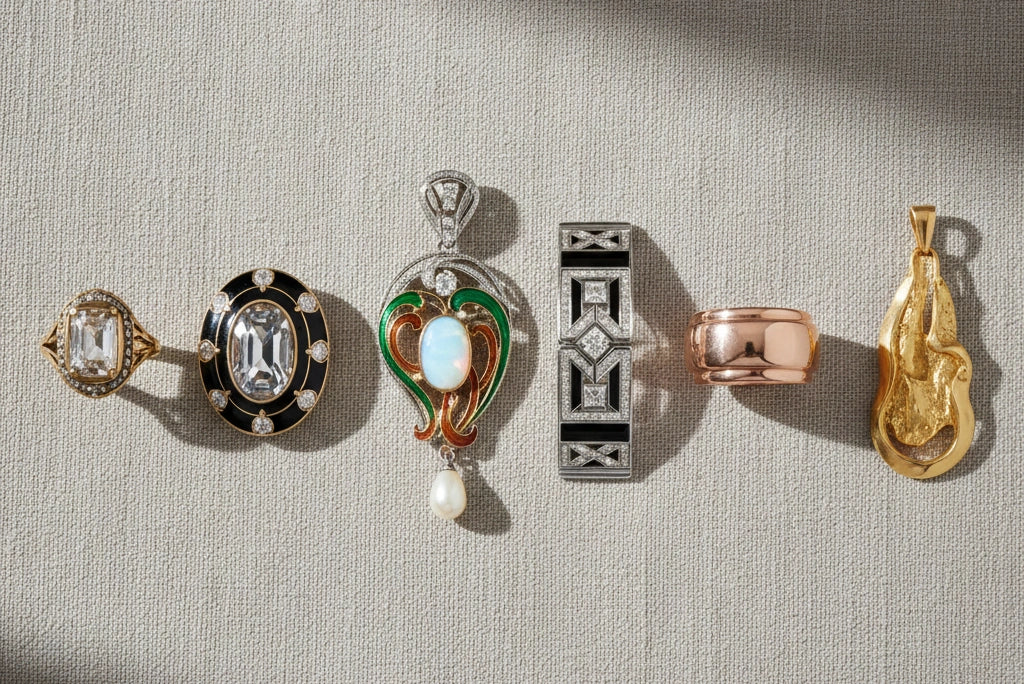
When you handle a true vintage piece, the differences become apparent before you examine hallmarks or dates. Weight, balance, and the way stones sit in their settings reflect decisions made by hand, using the tools and materials of a specific period. Those decisions define vintage jewelry style as a design language shaped by craftsmanship, construction methods, and cultural taste.
In this guide, you will learn what are vintage jewelry styles, how each era leaves clear signatures, and how you can identify them through metalwork, stone cuts, and settings.
What are Vintage Jewelry Styles?
Vintage jewelry styles describe recognizable design languages created during specific periods and shaped by the tools, materials, and skills available at the time. A vintage jewelry style reflects how a piece was constructed, how its stones were cut, and how its setting was engineered, rather than relying on age alone.
When you understand what are vintage jewelry styles, you begin to look for consistent physical traits. These traits include metal choice, stone cutting methods, and structural details that repeat across pieces from the same period. Each style carries clear, measurable features that allow you to identify it through close inspection, even when documentation is missing.
Quick Timeline of Vintage Jewelry Style by Era
-
18th century: Georgian
-
19th century: Victorian
-
Early 20th century: Edwardian
-
1890s to 1910s: Art Nouveau
-
1920s to 1930s: Art Deco
-
1940s: Retro
-
1950s to 1970s: Mid-Century Modern
1. Georgian Era Jewelry Style (1700s to Early 1800s)

Georgian jewelry emerges at a time when every element of a piece is shaped by hand and designed for candlelit settings. Its defining features lie in how metals are worked, stones are cut, and settings are constructed to manage light with limited technology.
Georgian Gold Alloys
Georgian jewelry relies on high-karat yellow gold as its primary structural metal, chosen for workability and rich color. Jewelers often cap diamond settings with silver-topped gold to increase brightness before the use of white metals. Early alloys vary in composition, which leaves subtle shifts in tone and surface texture that reveal hand finishing.
Georgian Gemstone Cuts
Gemstone selection and cutting reflect limited tooling and low-light environments. Common characteristics include:
-
Rose-cut diamonds with flat bases and domed crowns
-
Table-cut diamonds designed for surface reflection rather than depth
-
Foil-backed stones used to amplify color and light return
-
Garnet and topaz favored for durability and consistent color
These choices prioritize visual impact under candlelight rather than brilliance in modern lighting.
Georgian Setting and Fabrication Methods
Construction methods play a defining role in this vintage jewelry style. Jewelers rely on:
-
Closed-back settings and simple collets that fully enclose stones
-
Hand-fabricated mounts assembled through solder rather than casting
-
Repoussé work created by chasing metal from the reverse
-
Cannetille decoration formed from fine wire and granulated elements
These techniques produce subtle irregularities and layered detail that help distinguish Georgian jewelry from later reproductions.
2. Victorian Jewelry Style (1837 to 1901)

Victorian jewelry reflects a period of rapid change in taste, technology, and social values. As production methods expand and materials become more accessible, design moves from intimate, sentimental forms toward bolder, more expressive statements.
Materials and Techniques Across the Victorian Era
Across the era, jewelers work with a wide range of materials and finishes, including:
-
Rolled gold, used to create accessible pieces with the appearance of solid gold
-
Pinchbeck, a copper and zinc alloy designed to imitate gold
-
Niello inlay, applied to engraved recesses to create dark, graphic contrast
-
Black enamel, used in a controlled way to define outlines and symbolic motifs
Hand engraving remains common, with visible irregularity that reflects handwork rather than machine repetition. These shared techniques underpin the many Victorian styles you can still identify today and provide a structural foundation for the era’s evolving design phases.
The Evolution of Victorian Design Phases
Within this broad framework, Victorian design evolves through distinct phases that reflect changing emotional, cultural, and aesthetic priorities.
Early Victorian Romantic (1830s to 1850s)
Early Victorian jewelry centers on sentiment and personal meaning. Jewelers favor lockets, miniature compartments, and hair jewelry designed to hold personal keepsakes. Seed pearls appear frequently, often set in floral or symbolic arrangements that emphasize delicacy over scale. Gold work remains warm in tone, and construction still reflects hand assembly rather than full industrial production.
Mid-Victorian Grand and Mourning (1860s to 1880s)
Mid-century Victorian jewelry shifts toward weight and visual impact. Deep mourning traditions drive the use of jet, onyx, and black enamel, often paired with heavy yellow gold. Brooches grow larger and more architectural, designed to sit prominently on structured garments. As a result, metalwork becomes denser, and surfaces favor bold outlines over fine detail.
Late Victorian Aesthetic and Revival (1880s to 1901)
Late Victorian design moves away from strict mourning and embraces historical inspiration. Jewelers draw from Etruscan and archaeological revival styles, favoring textured gold surfaces and granulation effects. Crescent brooches, star motifs, and symbolic forms appear frequently, reflecting a renewed interest in ancient design language adapted to Victorian tastes.
3. Edwardian Jewelry Style (1901 to 1915)

Edwardian jewelry emerges during a period of technical refinement, where advances in metallurgy allow jewelers to work with unprecedented precision. Design shifts toward lighter construction and visual delicacy, setting this era apart from the heavier forms that defined late Victorian jewelry.
Edwardian Materials
Edwardian jewelry reflects a fundamental shift in metal use that transforms how pieces look and feel. Key materials include:
-
Platinum, valued for its strength and ability to hold stones with minimal visible metal
-
Early white gold, used to achieve a bright surface before platinum became widespread
-
Platinum-topped gold, combining durability with refined visual lightness
These materials allow for finer construction and support the era’s emphasis on delicacy and precision.
Edwardian Stone Layout and Visual Balance
This vintage jewelry style favors lightness, balance, and precision. Diamonds dominate, often paired with pearls to soften the overall look and add movement. Calibré sapphires appear as tightly fitted accents, used to trace outlines or introduce controlled color. Openwork construction allows light to pass through the piece, creating an airy quality that distinguishes Edwardian design from heavier Victorian forms.
Edwardian Settings and Finishing Methods
Finishing and setting techniques reinforce this delicacy. Common characteristics include:
-
Millegrain edges that define borders while protecting stone seats
-
Filigree and fine piercework that create lace-like frameworks
-
Knife-edge bars that maintain strength with minimal visual weight
-
Pavé and bead setting that secure stones while allowing metal to recede
These techniques keep the focus on gemstones while maintaining structural integrity.
4. Art Nouveau Jewelry Style (1890s to 1910s)
Art Nouveau jewelry emerges as a reaction against historical revival and industrial repetition. Designers shift focus toward artistic expression, treating jewelry as a sculptural medium shaped by nature, movement, and handcraft rather than formal symmetry. This shift defines the core principles of Art Nouveau design.
Art Nouveau Design Language
Art Nouveau jewelry rejects rigid symmetry and historical revival in favor of fluid, expressive form. The design language relies on:
-
Flowing, sinuous lines and organic curves
-
Nature-based motifs, including flowers, insects, and the human figure
-
Intentional asymmetry that creates sculptural presence
These elements replace architectural balance with visual movement and artistic interpretation.
Art Nouveau Stones and Surface Work
Gemstone selection supports this emphasis on visual effect over brilliance. Opal, moonstone, peridot, and garnet appear frequently, valued for color play and softness. Enamel becomes a defining surface treatment, with plique-à-jour enamel used to create translucent areas that allow light to pass through without a metal backing.
Art Nouveau Fabrication Clues
Fabrication techniques reinforce the artistic intent of this vintage jewelry style. Jewelers typically rely on:
-
Hand-applied enamel rather than machine processes
-
Sculpted relief forms instead of flat construction
-
Mixed metals within a single piece to separate elements or suggest motion
These methods produce natural variation and subtle irregularities that help distinguish period Art Nouveau jewelry from later reproductions.
5. Art Deco Jewelry Style (1920s to 1930s)

Art Deco jewelry emerges during a period that values order, modernity, and visual control. Design moves away from organic expression and toward precision, reflecting a broader cultural shift toward structure and engineered form.
Art Deco Geometry
Art Deco jewelry replaces fluid form with structure and precision. Design centers on bold symmetry, stepped forms, and strong geometric layouts. Clean negative space plays an active role, allowing repeated lines and precise proportions to define the piece without excess decoration. The overall effect feels architectural and intentional, with every element placed for balance.
Art Deco Gemstone and Cutting Style
Gemstone selection reinforces this disciplined aesthetic. Common characteristics include:
-
Old European and transitional diamonds used as primary stones
-
Baguette cuts that emphasize linear form and stepped geometry
-
Calibré-cut emeralds, rubies, and sapphires fitted tightly into borders
-
Onyx used to create depth and strong color contrast
These choices support the era’s preference for high-contrast, graphic compositions.
Art Deco Settings and Construction
Construction methods prioritize precision and strength. Jewelers commonly rely on:
-
Platinum and white gold to minimize visible metal
-
Channel settings that maintain uninterrupted surfaces
-
Calibré construction for tightly fitted stone layouts
-
Controlled pavé work to add texture without disrupting symmetry
-
Invisibility-inspired layouts that reduce metal presence
These techniques allow stones and geometry to dominate the visual impact.
6. Retro Jewelry Style (1940s)

Retro jewelry emerges during a period of material limitation and cultural adjustment shaped by wartime conditions. Design shifts toward heavier construction and bold presence, marking a clear departure from the refinement and restraint of earlier styles.
Retro Material and Construction
Retro jewelry reflects a decisive shift in both materials and proportions, shaped by wartime restrictions and changing tastes. Platinum use declines sharply, pushing jewelers toward 14K and 18K yellow and rose gold. These warmer metals support heavier construction and allow for bold surface modeling that defines the period’s visual identity.
Retro Forms and Proportions
Design favors volume and presence. Common forms include:
-
Tank rings with wide, architectural profiles
-
Scroll and ribbon-like motifs inspired by industrial design
-
Oversized, sculptural elements intended for immediate visual impact
Proportions grow larger and more rounded, with smooth curves replacing the strict geometry of earlier styles. The emphasis moves away from fine detail and toward strong silhouettes that maintain clarity at a glance.
Retro Stone Choices and Settings
Gemstone choices align with this bolder approach. Typical characteristics include:
-
Citrine and aquamarine selected for size and color impact
-
Synthetic rubies used due to material shortages and advances in synthesis
-
Bold prongs and flush-set accents that secure stones firmly
These setting choices reinforce the substantial, confident feel of Retro jewelry.
7. Mid-Century Modern Jewelry Style (1950s to 1970s)

Mid-Century Modern jewelry develops during a period of postwar stability and changing daily life, where design prioritizes function, comfort, and confident construction. Jewelry shifts toward repeatable forms and tactile finishes that feel intentional and wearable rather than ornamental.
Mid-Century Construction and Finishing
Mid-Century Modern jewelry reflects a shift toward confident construction and tactile surface work. Key construction and finishing traits include:
-
Cast components that allow consistent, repeatable forms
-
Assembled link systems used in bracelets and necklaces
-
Satin and Florentine finishes that emphasize texture
-
Deliberate high-polish contrast used to define form rather than decoration
These methods support durability while keeping visual focus on surface and structure.
Mid-Century Jewelry Categories
Design categories expand to match changing lifestyles. Common forms include:
-
Charm bracelets built as personalized, evolving compositions
-
Sculptural cocktail rings with bold profiles
-
Domed earrings designed for balanced volume on the ear
-
Modernist pendants with abstract shapes and simplified geometry
These categories reflect jewelry designed for daily wear rather than formal display.
Mid-Century Gemstones and Surface Design
Gemstone use reflects a move away from traditional brilliance toward visual character. Star sapphires, tiger’s eye, coral, and turquoise appear frequently, chosen for surface effect and color rather than faceting. Textured gold surfaces often serve as the primary design element, with stones acting as accents rather than focal points. This vintage jewelry style prioritizes form, finish, and wearability, resulting in pieces that feel intentional, solid, and distinctly modern for their time.
Conclusion
Vintage jewelry styles reveal themselves through physical evidence rather than labels. Metal choice, stone cutting, and construction methods carry the clearest signals of when and how a piece was made. When you learn to recognize these details, you can place a piece within its stylistic context with confidence.
Across the last three centuries, vintage jewelry style evolves through clear shifts in craftsmanship. Hand-fabricated gold gives way to refined platinum work, followed by bolder mid-century construction and textured modernist design. These changes reflect tools, materials, and cultural taste. Understanding these stylistic signatures gives you a reliable framework for judging authenticity and making informed decisions when you buy or collect vintage jewelry.